UX Case Study · Mobile App · Service Design · Solo

Steward

A Mobile App for a Professional Driver Service

Replacing a fragmented phone-and-spreadsheet workflow with a seamless mobile experience — eliminating scheduling errors, keeping drivers informed in real-time, and centralizing client management for a unique driving service.

Role
Solo UX/UI Designer & Researcher
Timeline
Jan – April · 4 months
Deliverables
Wireframes · Prototype
Tools
Figma · Adobe XD · Illustrator
4
Stakeholder interviews — drivers + owner
13
User surveys · 20 questions each
4 mo
Solo end-to-end · Research → Prototype
Problem Competitive Analysis Interviews & Surveys Personas User Journey Style Guide Wireframes Prototype

01 — Problem

A service running on calls and spreadsheets

The owner of a unique driving service wants to create a better experience for his clients and drivers. The goal: eliminate scheduling errors, keep drivers up-to-date with accurate information, and free up the owner's time to focus on neglected areas of the business.

Note: This case study focuses on the client (rider) experience only.

Users can only call the owner to schedule, update, or cancel — no self-service option.

All trip information transferred via recycled Excel spreadsheet texted or emailed to drivers.

No database or structure to store trip history, user preferences, or performance data.

Solution goal: Design a mobile app that creates a better experience for clients and drivers, streamlines operations, and frees up the owner's time for other areas of the service.


02 — Discovery

4 interviews · 13 user surveys · competitive analysis

I conducted in-person interviews with drivers and the business owner, plus a 20-question Google Forms survey to understand the client perspective. A competitive audit covered direct competitors (Dryver, iDriveyourcar) and indirect ones (Uber, Lyft).

Competitive Analysis
Current Service
0

Steward had no mobile app, self-service booking flow, or structured customer database.

Direct Competitors
2

Dryver and iDriveYourCar already offered web/mobile access around similar professional driver services.

Indirect Competitors
2

Uber and Lyft set user expectations for instant booking, live ride status, and transparent pricing.

Dimension
Steward
Dryver
iDriveYourCar
Uber / Lyft
Booking Channel
Phone-only
No self-service path
Web + app
Personal driver booking
Web + app
Corporate and personal
App-first
Instant ride request
Service Model
Designated driver
High-touch local service
Personal driver
Designated driver
Personal driver
Driver staffing
Ride sharing
Transportation network
Service Area
Fairfield County
Fairfield County
Fairfield County
Global coverage
Pricing Signal
Manual quote
Standard / hourly
Airport trips
Hourly
Hourly + gratuity
Distance + time
Variable rates
Design Opportunity
Centralize bookings, history, and preferences
Match digital access expectations
Reduce manual owner coordination
Borrow familiar ride-status patterns

Insight: Steward’s differentiator was not breadth or speed. It was a trusted, local, high-touch service. The product opportunity was to keep that trust while modernizing booking, trip visibility, and client records.

Direct: Dryver, iDriveYourCar · Indirect: Uber, Lyft
Personas
Portrait of Joseph
Rider Persona
Joseph
53 · Attorney · Easton · Married, 3 children

"Delays should not become an acceptable standard of service."

BioJoseph manages a packed client calendar and family schedule, often arranging transportation around meetings, school needs, and last-minute changes.

Goals

Protect work-life balance, serve high-value clients, and keep family travel dependable.

Needs

Confirmed ride details, trusted driver coordination, and fewer calls to keep plans aligned.

Frictions

Parking, coordinating plans with driving services, and limited trusted transportation options.

Portrait of Christina
Rider Persona
Christina
38 · Marketing Consultant · Westport · Married, 1 child

"It is good to know I can have a drink and get home safely."

BioChristina attends evening networking events where she wants to stay present, make connections, and know her ride home is already handled.

Goals

Generate leads, stay informed, and avoid potential DUI risk after networking events.

Needs

A safe return plan, visible pickup timing, and reassurance before the evening begins.

Frictions

Finding parking, inconvenient ride arrangements, and safety concerns that distract from her evening.

Portrait of Samuel
Rider Persona
Samuel
45 · Hedge Fund Manager · Darien · Married, 2 children

"Getting around in comfort helps relieve a stressful day."

BioSamuel moves between high-stakes work commitments and social obligations, relying on transportation that feels discreet, calm, and predictable.

Goals

Network with key stakeholders, reduce the stress of driving, and access current information.

Needs

Fast scheduling, discreet service updates, and a ride experience that reduces decision load.

Frictions

Complicated travel options, arranging transportation, and awkward gaps in service communication.

Insight: Designing for trust under time pressure

Clear Scheduling

Every rider needed confidence that plans would not fall apart, which pushed the design toward simple trip creation, visible ride details, and fewer handoff points.

Safety + Reassurance

Christina's event-based use case highlighted the need for dependable pickup timing, driver clarity, and a flow that makes getting home safely feel planned instead of improvised.

High-Touch Service

Joseph and Samuel valued a premium, low-friction experience, so the product needed to preserve personal service while adding centralized client history and trip communication.

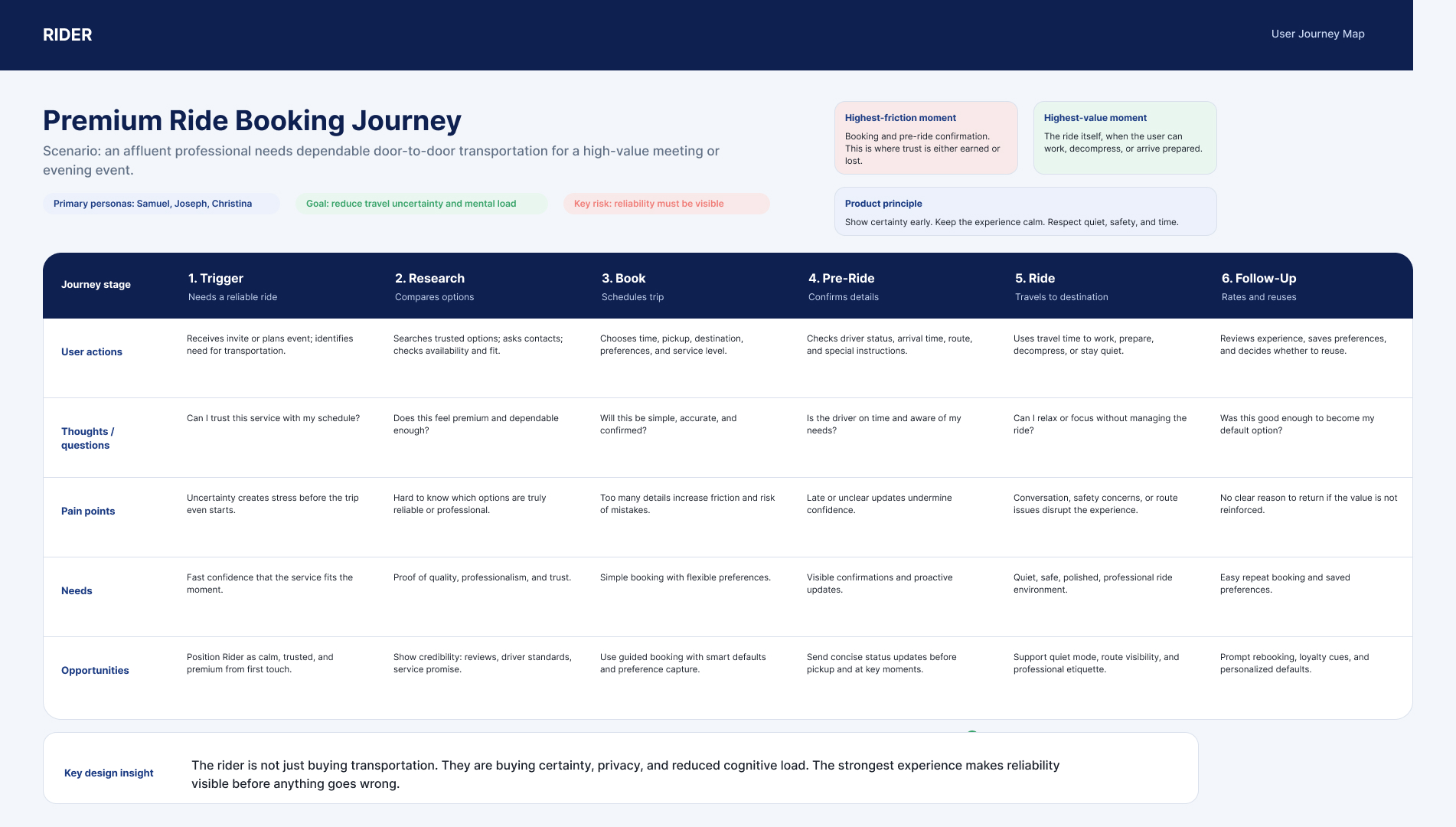
User Journey Map
User journey
Understanding how clients interact with the service end-to-end

Insight: The rider is not just buying transportation. They are buying certainty, privacy, and reduced cognitive load. The strongest experience makes reliability visible before anything goes wrong.


03 — Design

Style guide, wireframes, and prototype

Visual Styleguide
Steward uses editorial restraint, warm signal colors, and dense UI clarity.
Native system · no static image captures
Typography
Aa
Motion & Grace

"Type is the voice of the interface. In Steward, it speaks calmly, precisely, and only when needed."

The system pairs editorial elegance with functional clarity: Cormorant gives the product a premium service voice, while Inter carries dense trip, account, and status information.

Display
Steward
Cormorant SC

Headings, brand moments, page titles.

Editorial
On the Road
Cormorant Garamond

Quotes, subheads, nuanced emphasis.

Interface
Interface
Inter

Body copy, labels, navigation, data.

Color System
Foundation
Deep Space#0F1216App background
Obsidian#171B21Cards & panels
Slate#1E232BElevated surfaces
Boundary#2A313BLines & dividers
Accent + Semantic
Amber#F2A23CCTA, highlights
Amber Light#FFC97AHover, glow
Teal#5BBFB4Info, active state
Green#74C28ASuccess
Buttons

Amber primary actions, ghost secondary actions, and restrained radius.

Inputs

Dark fields with explicit focus, error, and success states.

Badges

Status pills for online, trip, alert, and info states.

Cards

Dense panels for trip details, metrics, and client records.

Wireframes

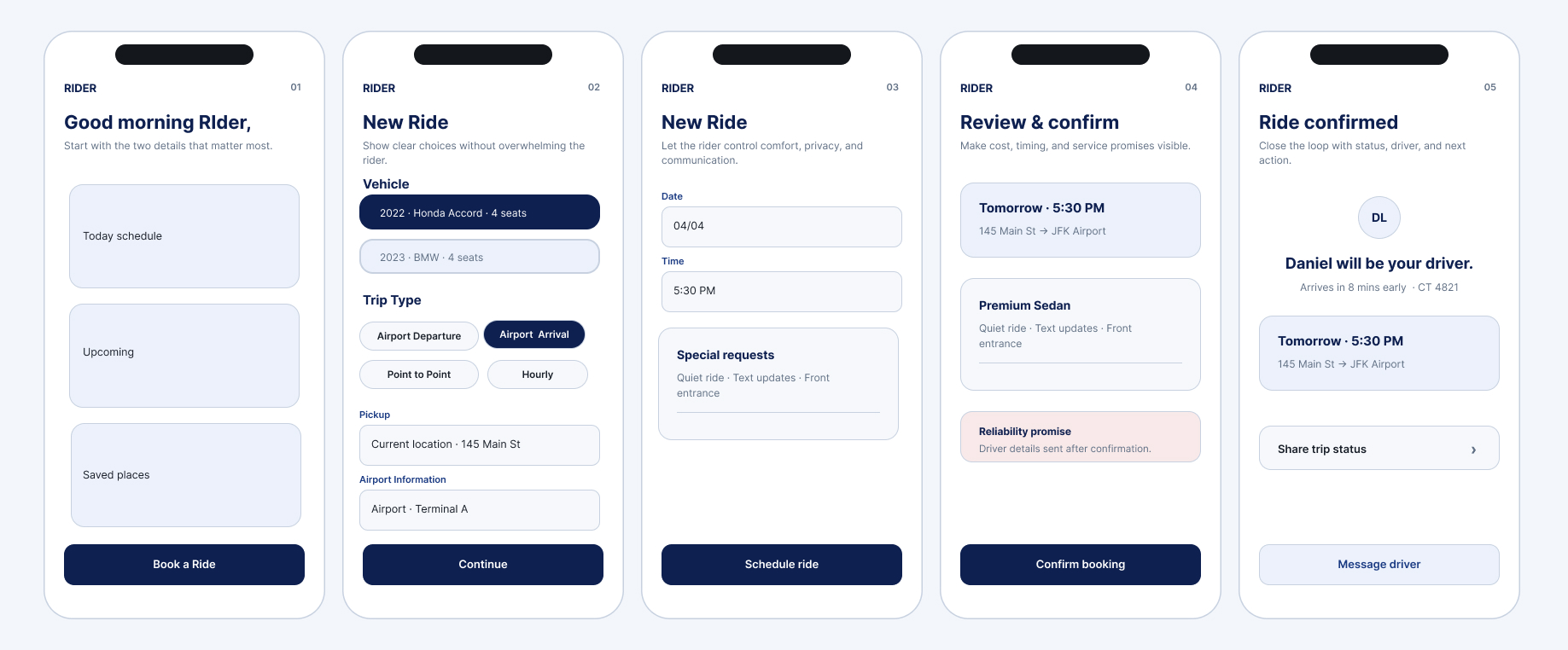
Booking a Ride Flow

Low-fidelity mobile wireframes focused on reducing uncertainty: clear pickup/dropoff, service selection, preferences, confirmation, and live ride status.

Flow goal

Help a premium rider book confidently in under a minute while making reliability visible before pickup.

UX principle

Every screen should answer: what is happening, what happens next, and can I trust it?

Booking a ride flow wireframe overview

Key flows: booking, preference setting, confirmation, trip status, and driver communication.

Mobile wireframe sequence · 5 screens
Prototype
Interactive prototype — client booking and ride tracking flows

04 — Outcome & Benefits

From phone calls to self-service

Steward replaces a fragmented, error-prone manual system with a mobile-first experience that empowers clients to self-serve, keeps drivers informed in real-time, and gives the owner a structured data foundation to grow the business. This project demonstrates the ability to translate a real small-business operational problem into an elegant, user-centered mobile solution.

Benefit 1

Eliminates scheduling errors — reduces the need to call in, minimizing risk of miscommunication.

Benefit 2

Drivers and clients receive up-to-date information about pick-ups, drop-offs, and changes in real-time.

Benefit 3

Personalized client management — tracks preferences, booking history, and feedback for ongoing improvement.

Want to discuss this project?

I'd love to walk through the research, design decisions, and prototype in more detail.

Get in touch