Partner
Your Goals. Your Journey. Your Trusted Assistance.
RESULT — Prototype validated across 4 usability-tested flows, positioning Partner for pilot with financial institutions.
An AI-powered financial companion that helps stressed adults manage bills, navigate uncertainty, and build lasting stability — with guidance that feels human.
The financial stress gap
Many financially stressed adults struggle to manage bills, absorb unexpected expenses, and make confident day-to-day decisions because they lack timely, actionable guidance and clear visibility into their financial reality. Stress, uncertainty, and reactive behaviors worsen instability rather than improve it.
16% already trust AI more than humans for financial advice — the door is open, but the right product doesn't yet exist.
6 interviews · 40–45 min · Zoom & in-person
Goal: gain insight into how participants currently manage finances, what emotional challenges they face, and how they perceive AI-based financial tools.
"I get really stressed out, sometimes depressed and at times I lash out."
Participant 1 — on managing finances"If my bank had an AI that helped me budget, I will feel like — okay, this is not a scam."
Participant 5 — on AI trust"Cut me off and say, you ordered pens 3x last week. You don't need anymore."
Participant 2 — on behavioral guardrails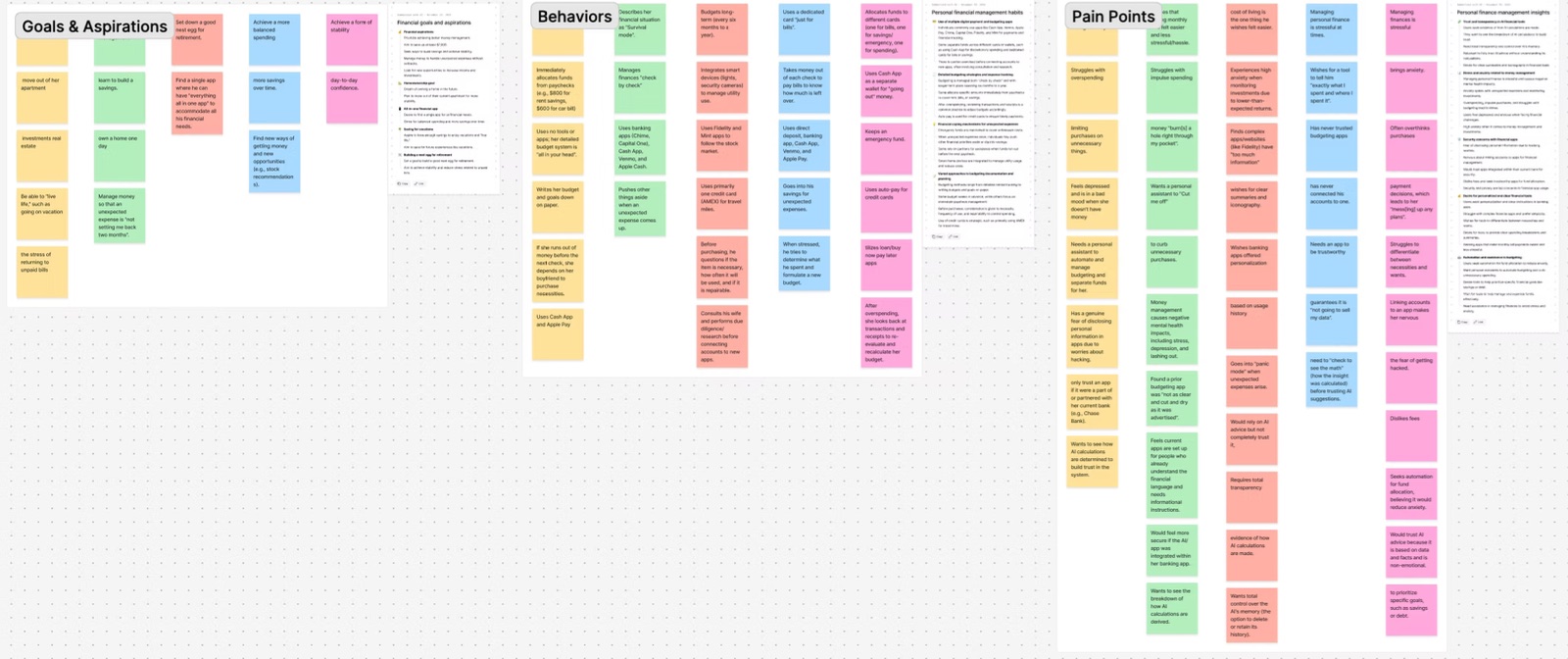
Users want a tool that acts as a "personal assistant" — performing budgeting, separating funds, and sending positive action alerts.
Do more than inform — actTrust increases significantly when guidance is tied to an established financial institution. Bank = legitimacy.
Institutional trust is the unlockUsers need a tool that helps build savings, plan for unexpected expenses, and gives confidence to achieve goals.
Progress visibility drives motivationParticipants want to see how suggestions were calculated — where the information comes from and why a recommendation was made.
Explainability drives trustUsers explicitly requested to be "cut off" in real time during moments of temptation or weak self-control.
Intervention > reflectionUsers described finances as "survival mode" — overwhelming and anxiety-inducing. Calm is a design feature.
Calm is a design featurePersonas & Journey Maps
Two data-grounded personas at different stages of their financial lifecycle, each with distinct behaviors preventing them from reaching their goals.
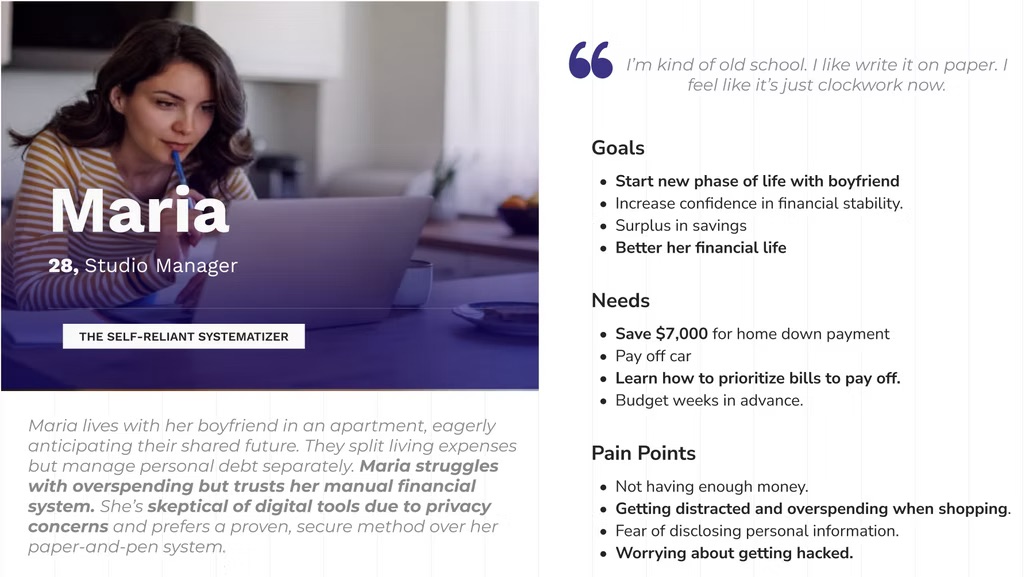
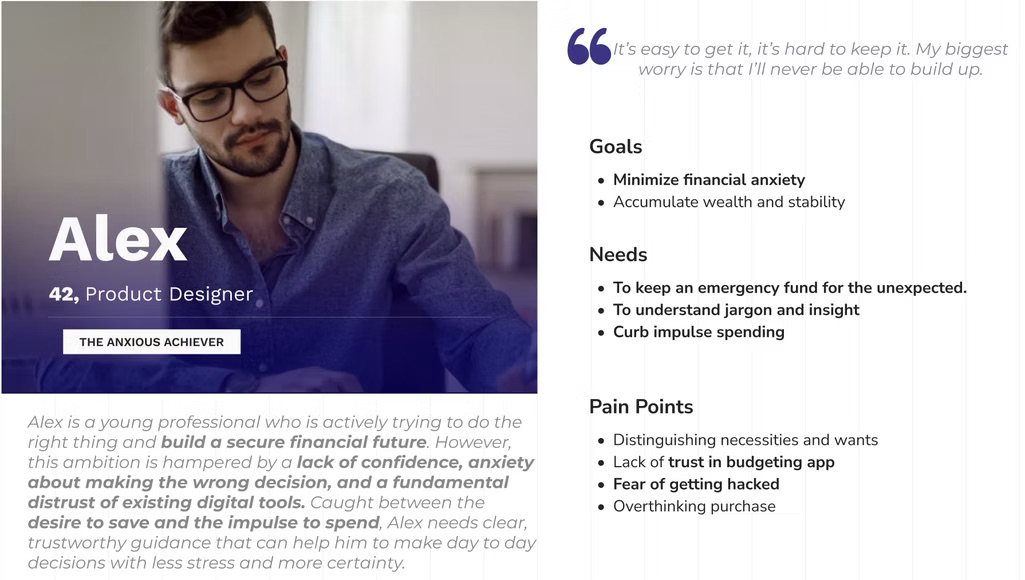
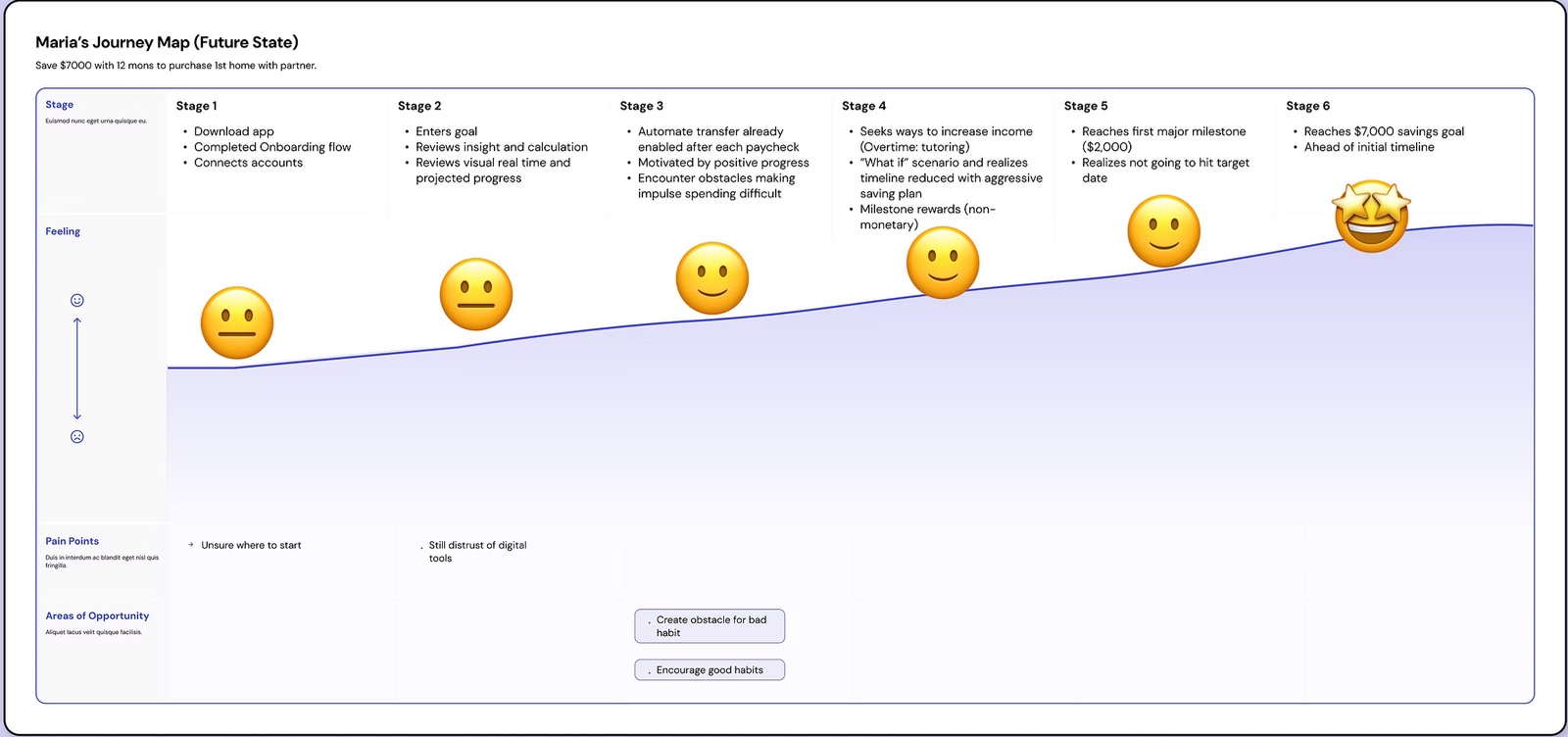
Strategic pivot: Instead of adding friction to alter behavior, I focused on removing obstacles to goals while seamlessly integrating healthier alternatives.
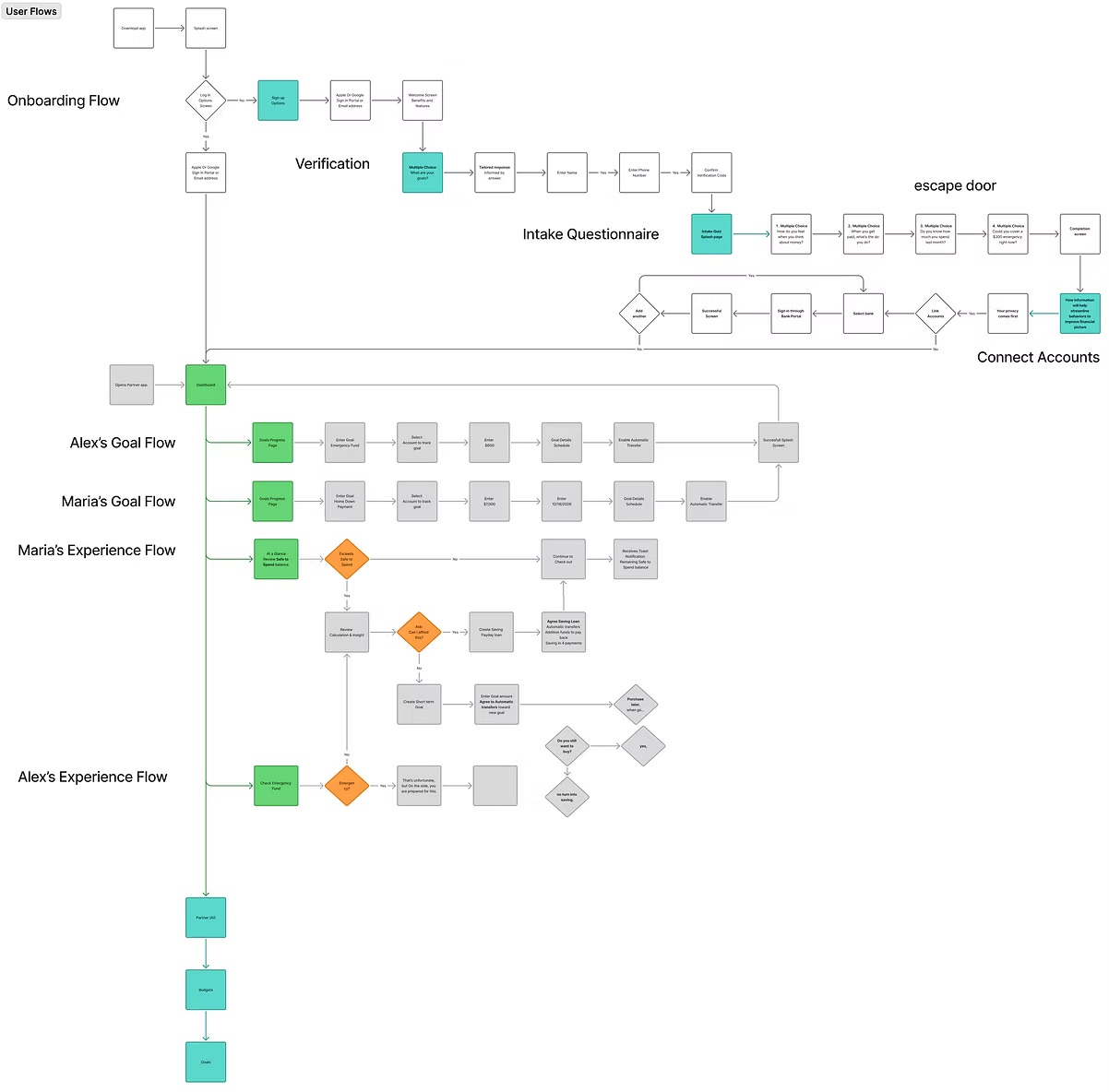
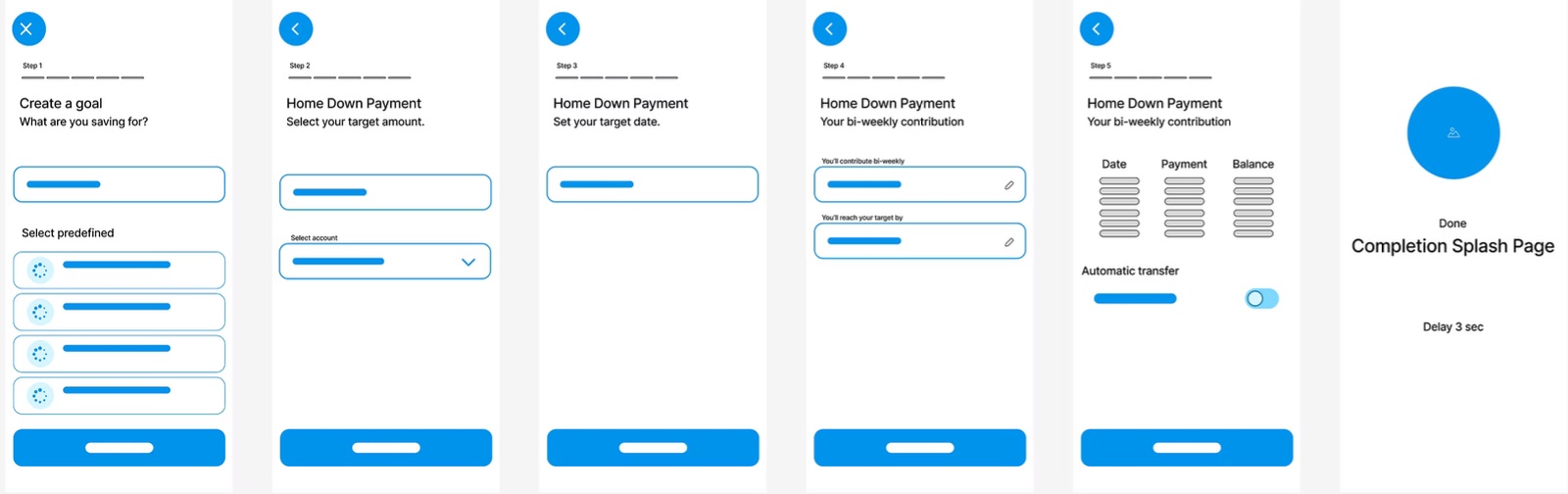
From wireframes to Partner's decision engine
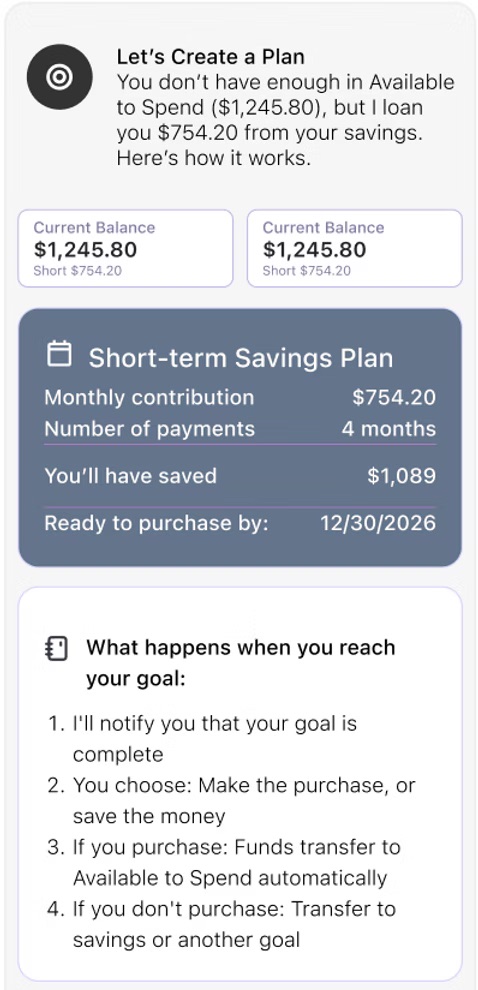
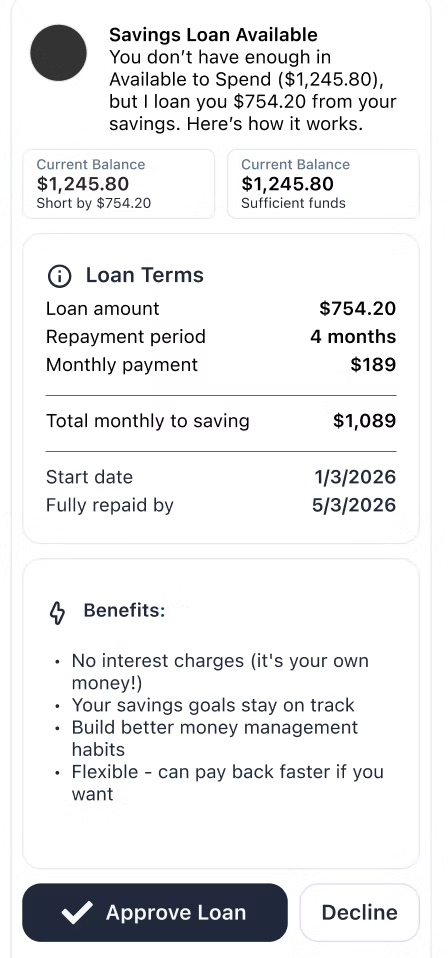
When a user wants to make a purchase they can't currently afford, Partner analyzes their income schedule and savings to offer two smart paths forward.
A loan drawn from the user's own savings — which must be paid back, keeping them on track for goals while freeing up cash now.
Automatically creates a savings goal — with user approval — to accumulate funds and make the purchase at the right time.
What Partner became
Partner is an institutional white-label guidance layer — a trusted, explainable financial assistant that helps users avoid preventable setbacks, manage behavior in the moment, and make steady progress toward financial stability. Designed to live inside existing financial institutions.
Trustworthy by design. Every interaction is explainable — Partner shows its reasoning and respects user autonomy at every step.
Guidance in the moment. Built around bill due dates, impulse buys, unexpected expenses — the small decisions that compound.
Complete usability testing → iterate → propose pilot to small financial institutions.
The key realization
"I realized that I was inadvertently designing for behaviors that prevent users from achieving their financial goals. Emotions lead users to choices not in their best interest, creating a painful cycle. Impulse spending often stems from negative self-perception. Coming to this realization has significantly enhanced my design skills."
What this demonstrates
End-to-end ownership of a complex, research-led product concept. Ability to translate qualitative insight into design decisions, AI interaction patterns, and a tested prototype — all as a sole designer.
Want to discuss this project?
I'd love to walk through my research process, design decisions, and usability testing insights.
Get in touch